
Goat Anatomy
August 21, 2012 by pwadmin
Filed under Raising Goats
Comments Off on Goat Anatomy
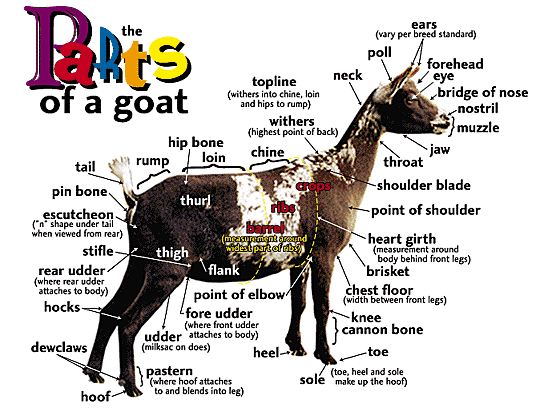
You call your vet about a problem in that ” lumpy area behind the front leg,” “thing-a-majig ” or ” doohickey,” in referring to the parts of your goat. Maybe its time to impress your vet and goat friends with a comprehensive knowledge of the parts of your goat by their anatomically correct names! This illustration will serve as a guide, but for those with text-only browsers, we offer the following text descriptions:
(Numbers in parentheses indicate total number of that part on the animal –
we list only those parts which can be viewed from the exterior.)
PARTS OF THE HEAD:
Poll (top of head where horns may or may not be located – 2), eyes, ears, forehead (1), bridge of nose (1), muzzle (which includes mouth, nostril and chin) and jaw (1) NECK, THROAT (the underside of the neck)
PARTS OF THE LEGS:
Moving up from the bottom: Hooves (made up of the toe, heel and sole – 4), dewclaws (those funny things above the hooves in the back of all four legs – 4), pastern (4), cannon bone (4), knee (front legs – 2), hocks (rear legs – 2)
Attachment of Rear Legs to Body:
Thighs (2), stifle (2), flank (2)
Attachment of Front Legs to Body:
Upper leg (2), Point of elbow (2), chest floor (area between front legs as viewed from the front – 1), point of shoulder (2), shoulder blade (2)
PARTS OF THE BODY:
Starting from the neck into the top of the animal: withers (1), chine (1), loin (1), hips (2), rump (1) and tail (1). The first five parts make up the animal’s topline.
Sides of the body: crops (below the withers – 2), ribs, thurl (2) Front: brisket (1) Circumference measurements: heart girth (around the body behind the front legs) and barrel (around the widest part of the ribs)
Underside: navel, milk vein (does only)
ESCUTCHEON: That area forming an upside-down “U” under the tail encompassing the anus, genitalia and rear udder attachment on does
EXTERNAL REPRODUCTIVE ORGANS:
Does: vulva, Bucks: scrotum and penis
UDDER PARTS: Rear udder (upper part of udder where it attaches to the body as viewed from the rear), Medial suspensory ligament (tendon bisecting the udder and providing support to the mammary system), udder floor, teats (2), Foreudder (where udder attaches to the underside of the doe)
Source: American Goat Society Judge’s Training Manual Photo courtesy of Shaula Parker, Willow Creek Nigerian Dwarfs, Willow Park, Texas
Mythological & Symbolic Significance of Goats
August 21, 2012 by pwadmin
Filed under Featured, Raising Goats
Comments Off on Mythological & Symbolic Significance of Goats
General
The goat has long been a visual aid in symbolic and mythological literature and stories. It has a varied significance: gentleness in one tradition and sensuality in another. Both sexes of the goat symbolize fertility, vitality and ceaseless energy. The he-goat (buck) is the epitome of masculine virility and creative energy, while the female (doe) typifies the feminine and generative power and abundance. Symbolically, the goat can be interchanged with the gazelle or the antelope. The wild goat of the Old Testament and Arabic lore is the Ibex.
The goat was probably, after the dog, the earliest domesticated animal. Goats grazing or at rest, or being milked by a goat-herder, are frequent subjects for idyllic scenes, representing the paradisial state; as such they appear on both pagan and Christian sarcophagi.
History
 There have been many strange beliefs and myths about goats. Oppian says they breathe through their horns, while Varro maintains that they breathe through their ears; Pliny expresses a general belief that they are perpetually feverish. Goat skins were used for water and wine bottles when traveling and camping and as parchment for writing. Goat hairs were woven and the animal provided food and milk. The goat, especially the kid, was a sacrificial animal and was used also as a sin-offering (the Scapegoat.) The he-goat is lust personified, and a goat with a human head depicts depravity.
Goats in Mythology
The Sumerian god Marduk often has a goat as an accompaniment, and it also appears with hunting goddesses. The wild goat was sacred to Artemis and is an attribute of Dionysos, who took this form when fleeing from Typhon, and of the satyrs, who are half-goats with goats’ horns. Pan also has the legs, horns and beard of a goat. Zeus Dictynnos was suckled by the goat Amalthea, whose skin became the aegis and her horn the cornucopia – she thus represented the protector and preserver, abundance and plenty. The goat was sacrificed to Faunus, who guarded the woods, fields and sheperds of flocks; also to the other nature gods such as Silvanus and Pan.
The goat was used as a draft animal and is depicted at such at Pompeii, with Dionysos/Bacchus reclining in a cart deiven by Cupid and drawn by goats. The she-goat was sacrificed to Artemis at her Athenian festival of Munichia. Herodotus says that the goat skin or aegis was worn by the statues of Athene in the Lybrian sacrifices and rites.
Goats in Religion
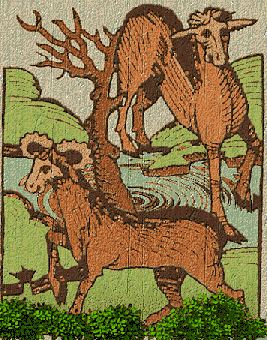 Goats and dogs were sacrificed at the Roman Lupercalia; the “Lupercal” was naked but for a goat skin and he carried goat-skin thongs for the ritual fertility whipping of women in the crowds who put themselves in his way to receive the fertility-magic. The goat, with the horse and dog, could not be touched by the Roman Priest of Jupiter, the Flamen Dialis. The Semitic goat-god Azazel symbolized life and creative energy.
The Hebrew sa’ir, goat, is rendered as satyr in the Old Testament (Isaiah 13: 21 and 34:14) and is an object of worship of false gods (Leviticus 17:7 and II Chronicles 11:15.) The goat also symbolized lewdness. This tradition was carried over into Christianity, where the goat represents the Devil, lust, lubricity and the damned while the sheep sumbolizes the saved. Christ is portrayed as the Scapegoat taking away the sins of the world. But in the Bestiaries, the goat, which climbs the highest peaks and possesses wonderful vision, depicts the highest perfection of searching and the gaze of Christ who sees all, past, present and future.
The Scapegoat
The use of a scapegoat to bear the sins of the entire community is a universal custom, appearing from the rites of ancient Babylon to those of modern-day Japan. The name is derived from the Hebrew ceremonies of the Day of Atonement (Yom Kippur,) when a goat was used to carry away the sins of the people into the wilderness, thus freeing them from the consequences. The scapegoat is delegated guilt and escape from the consequences of sin. The Hebrew Scapegoat was chosen from two goats, one of which was for the Lord. The other, the sin-bearer, was sent into the wilderness for Azazel (Leviticus 16:7-10.) In Christianity, the scapegoat is used as symbolic of Christ suffering for and bearing the sins of the world.
The Ibex
The Nubian Ibex is the wild goat of the Bible and a clean animal for the Hebrews. It is an Arabic symbol of beauty: “more beautiful than a wild goat.” Ibex horns are a frequent motif of Mesopotamian art and in the northern steppes of Asia. Pliny remarks on the great speed of the ibex and says that it hurls itself from heights and lands on its horns, which are elastic and can take the shock, thus it can bounce.
Goats in Folklore
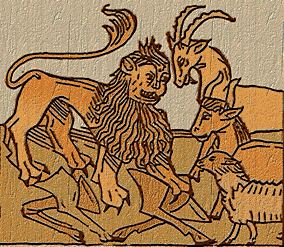 Arabic lore associates the stately march of the he-goat leading the herd with dignity of manner and bearing; but as contrasted with the meek sheep, it also symbolizes lawlessness, independence and straying. It is a sacrificial animal. The ram and he-goat are attributes of the Vedic Agni, god of fire and creative heat, who rides a he-goat.
Thor, Scandinavian god of thunder and fertility, has a chariot drawn by goats who are sacred to him; his goat Heidrun supplied the heavenly mead, the drink of the gods. In European literature and folklore, the goat often represented the determined, stubborn side of mankind.
Goats in Oriental Cultures
The Chinese goat spirit Yang Ching is the god of the stay Fan-yin; he is the transcendent goat with white face, horns, a long beard and a special head-dress. He is also a Mongolian god. In Chinese, the goat is a homophone of yang and so represents the solar, masculine principle; it also signifies peace and the good. Russia has a wood-spirit, the Leshi, which resembles Pan and the satyrs in having human shape with the horns, ears and legs of a goat. The goat is frequently used in Heraldry; with horns of a different color, it is said to be “armed.”
Angora Goats
August 21, 2012 by pwadmin
Filed under Goat Breeds
 About Fiber Goats

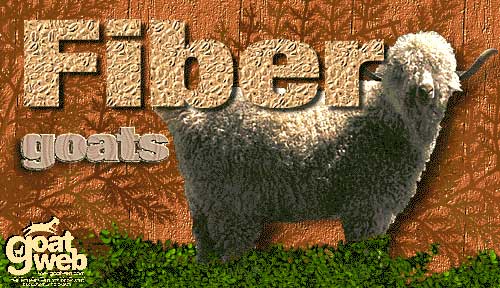
All goats have hair, but the hair of Angora and Cashmere goats is especially luxurious. Most goats have two kinds of hair – primary and secondary. Primary hairs are usually straight. Secondary hairs are usually curly. The main coat for most breeds, including diary goats, contains mostly primary hairs. Goats originating in cold climates have long primary hairs, making them look shaggy. As insulation against cold weather, some goats grow a coat of secondary hairs. Short, down-like secondary hairs are known as cashmere. The long, densely packed secondary hairs of an Angora goat are called mohair. On an Angora, primary hairs are called kemp and are undesirable.
Breed Description – Angora Goats
Angoras goats are believed to have originated in the Himalaya Mountains of Asia. They found their way to Turkey where the name Angora was derived from Andara, the name of the province where the goats thrived. Angoras were highly regarded and jealously protected from exportation until the nineteenth century.
The Angora goat’s history in the United States traces back to an 1849 importation, when Dr. James B. David of Columbia, South Carolina, was given seven does and two bucks by the Sultan of Turkey in gratitude for experimental work to improve Turkish cotton. By the time the Civil War began in 1861, a number of Angora flocks had been scattered through the South and Southwest as well as in the North and West. After the war, they moved to Texas and California.

The Angoras proved adaptable to a wide range of conditions, but they seemed most at home in the central and southwestern region of Texas, where ranges were large and offered a selection of browse particularly suited to them. They enjoyed a period of economic importance in such Western states as Utah, Arizona and New Mexico but since World War II, have tended to recede principally into Texas.
An Angora registry was established in 1900. The American Angora Goat Breeders Association has it headquarters in Rocksprings, Texas, in the very center of the principal remaining Angora range.
METHODS OF PRODUCTION
Billies are placed with the nannies in October so the kids will arrive from mid-February through March and sometimes into April. For the most part, nannies are allowed to kid unassisted on the range, but in some flocks, they are herded into pens and sheds for supervision. In earlier times, newly-born kids were tied to a stake and given small boxes to crawl under for shelter. The nannies were periodically brought to them for nursing until the kids were strong enough to be turned out safely into the pasture with their mothers. High costs have virtually eliminated such labor-intensive practices.
Angora goats are shorn twice a year in Texas. “Spring” shearing comes in early February through March, just ahead of kidding time. Because of the danger of late-winter cold rain, it is common practice to keep the freshly-shorn goats to small pastures with access to a barn or shed for at least a few days after shearing. This makes it easy to pen and shelter them at night, or even in daytime if a weather emergency arises. It is common practice in some areas at spring shearing to leave an unshorn strip know as a “cape” down the back to protect the animal’s cold-sensitive spine. Usually – but not always – this cape is later removed by a raised shearing comb or hand shears which leaves a stubble similar in length to the regrowth elsewhere on the body.
“Fall” shearing runs from mid-July through August. Usually the goats are shorn to the skin at this time, leaving them vulnerable to unseasonably cold rains, which on occasion may cause more losses in fall than in spring. Angoras normally produce three-fourths to an inch of hair growth per month, making adult hair average four to six inches in length at each of the semi-annual shearing.
For many years, Angora goats were bred more for hair production than for kid production, at some cost to their basic fertility. In addition, it has not been traditional for ranchers to give goat nutrition the dedication provided to nutritional needs of their sheep and cattle, though research has shown the Angora goat to have the most critical nutritional requirements of any common Texas livestock species. Fortunately, good mohair prices have encouraged increasing rancher attention to this neglected area. Angoras on most ranches today are fed better and managed with a care they never had before, resulting in much-improved kid crop percentages and a longer useful life for adult goats.
EXPORT SALES OF MOHAIR

In recent years, nearly all Texas mohair has been going to overseas users. Over 90 percent of the total clip has been exported with the greatest quantity going to the United Kingdom. Other European countries account for most of the rest, with Japan getting a small but significant amount.
Mohair is usually loaded into containers at the warehouse in approximately 35,000 pound quantities. These containers are transferred to the port for transport overseas. Most commonly, that port is Houston. As mohair use in the United States has declined, so have the processing facilities for scouring and combing of mohair. These are concentrated in two cities: San Angelo and Brady, in the heart of the producing area. this simplifies the shipping problem for users who want mohair processed before shipping overseas.
Kemp and medulated fiber content in good quality lots of Texas mohair is usually less than 2 percent. This compares favorably with mohair produced anywhere in the world. Mohair fiber is graded by its width in microns and classified as top, grease mohair, card sliver and noil.
Source: Mohair Council of America, P.O. Box 5337, San Angelo, Texas 76902
Photos: Roving Jacobs
Visit our Breeds & Breeding forum section and our fibers section!
Boer Goats
August 21, 2012 by pwadmin
Filed under Goat Breeds
Comments Off on Boer Goats
American Boer Goats
The American Boer Goat is one of the hardiest of all livestock breeds. Bred for dominance, it has a high resistance to disease, adapts well to various climates and terrains and has outstanding size and rate of growth. The Boer goat reaches puberty early, and with proper care, is able to kid every eight months. It also has a high percentage of multiple births. Furthermore, the Boer goat maintains economic production for ten years or longer. These characteristics, combined with the market potential of Boer goat products, have stimulated unprecedented interest in the goat industry.
History of the American Boer Goat
 The breeding for today’s American Boer Goat began in the early twentieth century in South Africa with a group of ranchers who made it their goal to breed the world’s best goat. Through decades of selective breeding, the Boer gained its genetic superiority and nobility. In 1959, the South Africans formed the world’s first Boer Goat Breeders’ Association, and from that time on the Boer goat has distinguished itself as a unique breed of livestock.
Most of the Boers found in the United States today were imported from South Africa via a quarantine stop in New Zealand. While in New Zealand, the goats prospered under fertile climate conditions that were different from the dry range of South Africa, proving the Boer goat’s adaptability.
In 1993, the first Boers were brought to America by stockmen with a vision – to see the Boer goat affect the growing goat meat market in the United States and in the world. From the southern tip of the African continent to the ranches of America, this goat has seen only a portion of the world that awaits it.
Boer Breed Standards
In describing the traits which constitute “standards” for the American Boer goat, we are leaning heavily on the standards which evolved during the development of this breed over the past 70 years in South Africa. The south Africans developed standards explicitly to improve the breed. The South African Boer goat is a recognized breed in its country of origin, and experts throughout the world consider this to be the premier breed of meat goat.
| Head: | A prominent, strong head with brown eyes and a gentle appearance. Nose with a gentle curve, wide nostrils, and well formed mouth with well opposed jaws. Horns should be strong, of moderate length, positioned well apart, and have a gradual backward curve before turning outward symmetrically. Ears should be broad, smooth, of medium length and hang downwards. |
| Neck & Forequarters: | Neck of moderate length and in proportion with body length. Forequarters full, well fleshed and limbs well jointed and smoothly blended. Breast should be broad with a deep brisket. Shoulders should be fleshy and legs proportional and strong. |
| Body: | Body should be long, deep and broad. Ribs must be well sprung and muscled. Loins should be well muscled, wide and long. The top line should be straight and the shoulders well rounded. |
| Hindquarters: | Rump broad and long, with a gently slope. Britch and thighs well muscled and rounded. Tail should be centered, straight and curve upwards to one side. Legs should have a straight axis from the hip to the hock. |
| Skin & Covering: | Skin should be loose and supple, with sufficient folds over the neck and chest, especially in bucks. Hairless around the anus. Short glossy hair is desirable. |
|
Source: American Boer Goat Association, P.O. Box 248, Whitewright, Texas 75491 |
|
National Breed Club
American Boer Goat Association
Bruce Lott, Executive Secretary
232 W Beauregard, Suite 104
San Angelo, TX 76903
(915) 486-abga (2242)
(915) 486-boer (2637) fax
info@abga.org
We are your association, dedicated to promoting and enhancing your experience and enjoyment of Boer goat breeding and husbandry. This website provides all the resources, or connections to them, that you will need to successfully raise and show the finest breed of meat goat in America today – The American Boer Goat.
Visit our Goat Forum !
Toggenburg Goats
August 21, 2012 by pwadmin
Filed under Goat Breeds

American Dairy Goat Breed Description
The Toggenburg is a Swiss dairy goat from the Toggenburg Valley of Switzerland. This breed is medium size, sturdy, vigorous, and alert in appearance. The hair is short or medium in length, soft, fine, and lying flat. Its color is solid varying from light fawn to dark chocolate with no preference for any shade. Distinct white markings are as follows: white ears with dark spot in middle; two white stripes down the face from above each eye to the muzzle; hind legs white from the hocks to hooves; forelegs white from knees downward with dark line (band) below knee acceptable; a white triangle on either side of the tail; white spot may be present at root of wattles or in that area if no wattles are present. Varying degrees of cream markings instead of pure white is acceptable, but not desirable. The ears are erect and carried forward. Facial lines may be dished or straight, never Roman.
Breed Description
The Toggenburg from Switzerland may tend to be the most angular of the major dairy breeds, being small and compact and showing a lot of width and depth. The head is wide between mellow eyes, and it supports short, narrow, alert ears. The muzzle is also deep and wide, but the bridge of the nose is strongly concave or “dished”. The coat may be long when not trimmed, and the hair is fine. The color is some shade of brown with white lining on the ears, white facial stripe, white lower legs, and white triangles at the base of the tail.
ORIGIN: Switzerland
National Breed Club
National Toggenburg Club
Debby O’Brian, Sec-Treas.
20020 Maxwell Road SE
Maple Valley, WA 98038
425-432-8551
425-432-1021 (FAX)
obwebioc@earthlink.com
Dues: $15
NTC promotes Toggenburgs through the All-American program (outstanding show stock), Production Awards: Bell Ringers (high milk & fat production), Show Reports (ADGA show wins), Linear Appraisal Reports (by herd), sponsorship of Specialty shows (reports & photos printed in Togg News) & through publication of an informative bimonthly newsletter. Members with outstanding show win animals, high linear appraisal scores & Production Testing records are recognized.
Visit our Breeds & Breeding forum section and our milking section!
Saanen Goats
August 21, 2012 by pwadmin
Filed under Goat Breeds

American Dairy Goat Breed Description
The Saanen dairy goat originated in Switzerland. It is medium to large in size with rugged bone and plenty of vigor. Does should be feminine, however and not coarse. Saanens are white or light cream in color, with white preferred. Spots on the skin are not discriminated against. Small spots of color on the hair are allowable, but not desirable. The hair should be short and fine, although a fringe over the spine and thighs is often present. Ears should be erect and alertly carried, preferably pointing forward. The face should be straight or dished. A tendency toward a Roman nose is discriminated against.
The Sable dairy goat is medium to large in size with rugged bone and plenty of vigor. Does should be feminine, however, and not coarse. Mature does must be at least 30 inches (76 cm) in height and weigh at last 135 pounds (61.36 kg). Mature bucks must be at least 32 inches (81 cm) in height and weigh at least 170 pounds (77.27 kg). Their hair is short; ears should be erect and alertly carried, preferably pointing forward. The face should be straight or dished.
The Sable dairy goat, either purebred or American, must be the offspring of purebred or American Saanens, Sables, or Experimental (when of wholly purebred or American Saanen bloodlines). The Sable must also meet the color requirements; a Sable may be any color or combinations of colors, solid or patterned, EXCEPT solid white or light cream. This would include goats who are basically white but have dark spots, ticking, etc., which preclude them from entry into the Saanen herd books.
This breed is presently not recognized by the American Dairy Goat Association, but the standard is published as a guide for breeders who are working with colored Saanens.
Breed Description
The Saanen may appear almost as rangy as the Alpine, but she will be larger and heavier, containing more “substance.” The length of the head resembles the Alpine, but the ears may be longer and the eyes more mellow. The muzzle will be wider and deeper, and the bridge of the nose will be nearly straight, with less “dish” than other breeds. The Saanen must be pure white with no markings, although shades of cream may be acceptable. The hair often grows quite long, and it may tend to be heavier and perhaps coarser. The pure white color refers to hair color only. Spots of black pigment on the skin, like freckles, are normal.
The Sable is a colored offspring of registered, purebred Saanens, so the conformation is about the same as for the Saanen. The color can be any color other than cream or white.
ORIGIN: Switzerland
National Breed Club
National Saanen Breeders Association
Justine Gilchrist, Sec-Treas.
8555 Sypes Canyon Road
Bozeman, MT 59715
406-586-2786
gilchrist@montana.campuscw.net
Dues: $15
When you belong to NSBA, you receive our award winning newsletter Saanen News Quarterly, can have your special Saanens featured on the club breed page of United Caprine News, can participate in the club’s All-American & Production Awards programs, receive inside information on Saanens throughout the country, & have the opportunity to join in active promotion of the Saanen breed. We also hold Saanen Specialty shows across the nation.
Visit our Breeds & Breeding forum section and our milking section!
Oberhasli Goats
August 21, 2012 by pwadmin
Filed under Goat Breeds
Comments Off on Oberhasli Goats
American Dairy Goat Breed Description
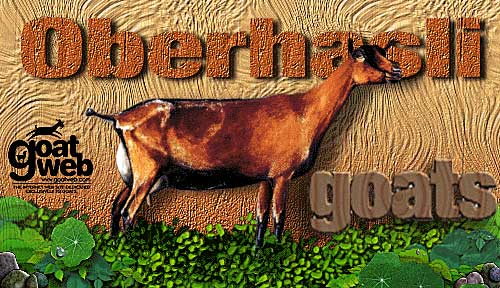
The Oberhasli is a Swiss dairy goat. This breed is medium size, vigorous and alert in appearance. Its color is chamoisee. Does may be black but chamoisee is preferred. Chamoisee is described as: Bay – ranging from light to a deep red bay with the latter most desirable. A few white hairs through the coat and about the ears are permitted. Markings are to be: two black stripes down the face from above each eye to a black muzzle; forehead nearly all black, black stripes from the base of each ear coming to a point just back of the poll and continuing along the neck and back as a dorsal stripe to the tail; a black belly and light gray to black udder; black legs below the knees and hocks; ears black inside and bay outside. Bucks often have more black on the head than does, black whiskers, and black hair along the shoulder and lower chest with a mantle of black along the back. Bucks frequently have more white hairs through the coat than does. The face is straight. A Roman nose is discriminated against.
Breed Description
The Oberhasli is a pure breed of dairy goat found in the Brienzer region of Switzerland near Bern, where it is known as the Oberhasli-Brienzer. It was formerly called the Swiss Alpine in the USA. It is shorter and heavier than the French Alpine, with a shorter, wider head. Its color is distinctive, being chamoisee, ranging from light bay to dark mahogany with black ears, facial stripes, dorsal stripe, bell, cannons and udder (after its been exposed to the sun.) It is less “leggy” than the Alpine, but not quite as compact as the Toggenburg may be.
ORIGIN: Switzerland.
National Breed Club
Oberhasli Breeders of America
Jan Bothwell, Sec-Treas.
11620 Sunset Court
Montague, CA 96064
530-459-3999
530-459-0409 (FAX)
bothwell@snowcrest.net
Dues: $12
The Oberhasli Breeders of America is dedicated to the development, promotion, & advancement of the Oberhasli. The club is for the encouragement of closer fellowship among members through meetings, correspondence, and circulation of useful information, news, and ideas. Our awards programs include All-American, Specialty, & Swiss-Belle Awards. The newsletter is published five times yearly.
Visit our Breeds & Breeding forum section and our milking section!
Nubian Goats
August 21, 2012 by pwadmin
Filed under Goat Breeds
Comments Off on Nubian Goats
American Dairy Goat Breed Description
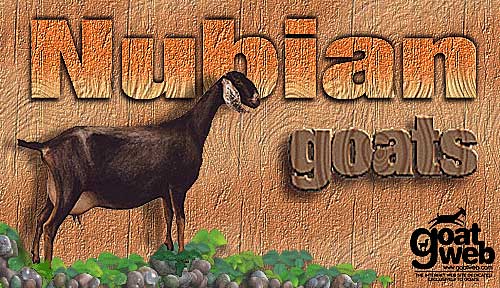
The Nubian is a relatively large, proud, and graceful dairy goat of Oriental origin, know for high quality, high butterfat milk production. The head is the distinctive breed characteristic, with the facial profile between the eyes and the muzzle being strongly concave. The ears are long, extending at least one inch (2.54 cm) beyond the muzzle when held flat along the face. They lie close to the head at the temple and flare slightly out and well forward at the rounded tip, forming a bell shape. The ears are not thick, with the cartilage well defined. The hair is short, fine, and glossy. Any color or colors, solid or patterned, is acceptable.
Breed Description
The Nubian should have the angularity and smoothness of the other breeds; it will have a tendency to more fleshiness, especially in the withers and thighs, and more slope to the rump due to slightly higher hip bones, which may also give the topline a slope downward to the withers. Nubians may appear to be rounder boned than the other breeds. Nubian ears, instead of being short, narrow and alert, will be wide, flat, flared forward at the ends and pendulous. They should extend past the end of the muzzle when held flat along the face. The muzzle should be almost as wide and deep as that of the Toggenburg, and the width between the sleepy, droopy-lidded eyes should be great, but between the eyes and muzzle is a lot of difference. The bridge of the nose should arch severely forward, forming a strong, convex shape, or Roman nose. The Nubian, like the Alpine, may be any color, and the coat will probably be short, fine and sleek.
ORIGIN: African and Indian heritage, combined in England.
National Breed Club
International Nubian Breeders Association
Wilma (Sam) Behrman, Sec-Treas.
2750 W. 1050 S.
Columbus, IN 47201
812-522-5094
wcnubians@aol.com
Dues: $10
You are invited to join the INBA & keep abreast of all the happenings in the Nubian goat world. We publish an annual membership directory so you can contact others who love Nubians, too. A 40+ page newsletter featuring Nubian goat stories, specialty shows, pictures of top bucks & does, & more is published for members quarterly. We recognize high production records, excellence in linear appraisal, the All-American program & give dam & sire awards.
Visit our Breeds & Breeding forum section and our milking section!
LaMancha Goats
August 21, 2012 by pwadmin
Filed under Goat Breeds
American Dairy Goat Breed Description
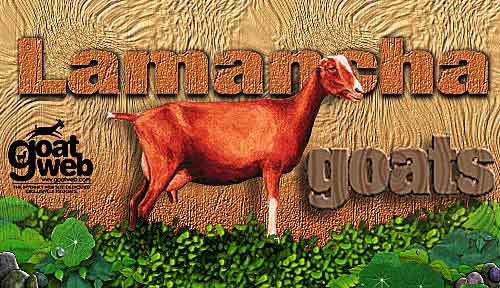
The LaMancha goat originated in the U.S.A. It has excellent dairy temperament and is an all-around sturdy animal that can withstand a great deal of hardship and still produce. Through official testing this breed has established itself in milk production with high butterfat.
The LaMancha face is straight with the ears being the distinctive breed characteristic. There are two types of LaMancha ears. In does one type of ear has no advantage over the other.
1. The “gopher ear” is described as follows: an approximate maximum length of one inch (2.54 cm) but preferably nonexistent and with very little or no cartilage. The end of the ear must be turned up or down. This is the only type of ear which will make bucks eligible for registration.
2. The “elf ear” is described as follows: an approximate maximum length of two inches (5.08 cm) is allowed, the end of the ear must be turned up or turned down and cartilage shaping the small ear is allowed.
Any color or combination of colors is acceptable with no preferences. The hair is short, fine and glossy.
The LaMancha may carry a little more flesh than the Swiss breeds do, but not as much as the Nubian. LaMancha ears are the most obvious breed difference. They almost do not exist. Gopher ears, which are a must on bucks, contain no cartilage. They appear as wrinkled folds of skin that lie close to the head. Elf ears, which may be found on does, come in many shapes and sizes, contain cartilage and skin, and they must look very small in comparison with the size of the doe’s head. The head and muzzle should be wide, as in the other breeds, and the nose will probably be concave. Any coat color is acceptable, and the hair is short and fine.
ORIGIN: American by mutation; originals from Spain.
National Breed Club
Judith Hoy, Sec-Treas.
1924 Mt. Pleasant Road
Port Angeles, WA 98362-9364
360-452-5903
star@olypen.com
Dues: $15
Our goal is to promote the LaMancha dairy goat & assist all LaMancha dairy goat owners & breeders including commercial dairymen, cheese producers, exhibitors, & hobby enthusiasts. The ALC provides annual awards for production, the All-American program, & seeks to recognize the efforts of those who contribute to the breed. Our bimonthly newsletter (also provided on audio tape for the visually impaired) includes a special membership issue & annual buck catalog.
Visit our Breeds & Breeding forum section and our milking section!
Alpine Goats
August 21, 2012 by pwadmin
Filed under Goat Breeds
Comments Off on Alpine Goats
American Dairy Goat Breed Description
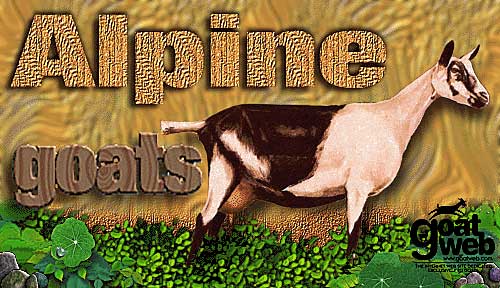
The Alpine dairy goat is also referred to as the French Alpine and registration papers for this dairy goat use both designations and they are synonymous. The Alpine dairy goat is a medium to large size animal, alertly graceful, and the only breed with upright ears that offers all colors and combinations of colors giving them distinction and individuality. They are hardy, adaptable animals that thrive in any climate while maintaining good health and excellent production. The hair is medium to short. The face is straight. A Roman nose, Toggenburg color and markings, or all white is discriminated against. Alpine colors are described by using the following terms:
National Breed Club
Alpines International
Dave Battjes, Sec- Tres.
4217 12th Street
Wayland, MI 49348
battjesd@aol.com
Dues $10
The Alpines International club is active in promoting the accomplishments of the Alpine breed in both the milking parlor & the show ring. We offer members an informative brochure, bimonthly newsletter, advertising & doe photos on the Alpine page in the Dairy Goat Journal, participation in the All-American Program & Alpine Specialty shows, & publication of performance scores in the club newsletter.

Visit our Breeds & Breeding forum section and our milking section!